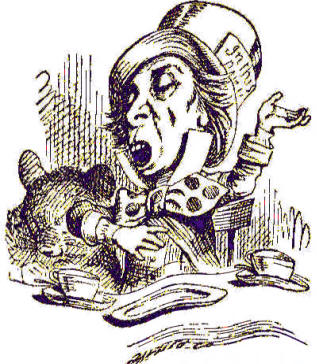
I thought I'd post an essay I did for my last quarter's english class. The assignment was to read Through the Looking Glass and Alice in Wonderland and make an analysis of them(only rule being you couldn't use the old drug-use analysis!). Looking at this again, I think I could have really improved it. Very little of my personality shows through and the ending is VERY rushed... but I had very little time to write it! I like some of the things I wrote about though and figure maybe it'd make for some good discussion.
Check it out! I've even included some great pictures to make the text easier to read.
ALICE IN WONDERLAND/THROUGH THE LOOKING GLASS-- ANALYSIS

Both books, on the surface would seem to be childish nonsense. Crying a river of tears? Playing croquet with flamingos? Eating teacups? Talking chess pieces? Pure unadulterated poppycock!
However, if one takes the time to look deeper, they’ll find a story of a young girl’s growth into a woman and gain an intense understanding of society.
At the start of Alice in Wonderland, you’ll find Alice with her older sister who is reading a strictly no-nonsense book lacking pictures and conversations. A right and proper thing for an English woman of the 1800s to do, but Alice, not having all the rules of society ingrained in her mind and still having some of that childhood innocence, found it to be a useless exercise. She began to daydream, as characterized by the white rabbit, and eventually fell into a deep sleep, as characterized by the fall into the rabbit hole.
When she finally reached the bottom of this fall (or finally reaching the deepest of sleeps and the real start of her dream) she was met with a hall full of doors. None of them but one would open with the single key she had found, but yet that one door was one she could not enter. This calls for Freudian interpretation.

I remember a Disney film by the name of “Donald in Mathmagicland” which used a similar format to explain a journey of discovery. There was a point near the end where Donald was met with a hall full of doors. Donald vivaciously explored many of them but eventually came to halt and found he could not open any more that lay further down the hall. The ominous narrator described these doors as “The Doors of the Future” that must be unlocked through the power of mathematics.
“Donald in Mathmagicland” obviously had some elements of “Alice in Wonderland” within it, so perhaps the doors in “Alice in Wonderland” are time-related as well. So if we take these locked doors again as “The Doors of the Future” we remember that Alice is still a young girl and has much to learn. She cannot access these doors until she ages. What do we do as we age? We reminisce. So consider that perhaps these doors don’t lead TO the future, but would in fact show us the past. Alice has access to one of these past doors. What past does Alice have? I thought of her as a girl of about 10 (she can’t be much older)… so she would only have her younger childhood to look back to. In most cases, our childhoods are bright, colorful and filled with memories of playing outside. So when she opens this door, she sees a beautiful garden that may represent the simple pleasures of her childhood.
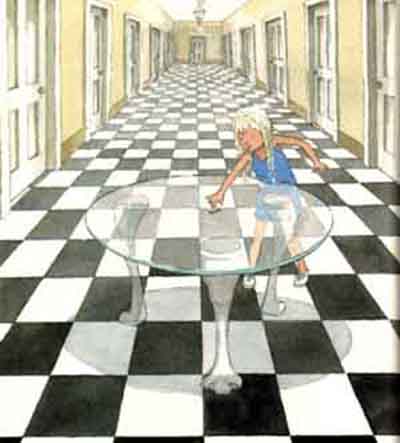
Anyone would want to go back, right? But poor Alice can’t seem to get to the right size to fit through the door. As much as she eats and drinks she’s either too big or too small (can’t pick up the key) to get through. Frustrated, she cries so many tears that she literally makes an ocean!
If we continue to believe she is about 10 years old, one could see this as a metaphor for her transition from childhood in adolescence. Puberty is a confusing time, and almost everyone questions whom he or she is and why they are going through so much. To bring the door and garden back into view; one can look at their past, but can never go back to it. Considering how simple childhood is, I’m sure we’d all like to go back to it every now and again to escape the pressures of adult life. Granted, she’d need a couple more years to really feel the transition, but considering girls historically go through puberty sooner than boys I think the analogy is still sound.

She never gets through that door, but the sea of tears allowed her another path. Floating to an island she met the Mouse and a host of other creatures. Alice wished to hear his story but kept interrupting with constant questions and after a while tuned him out altogether. After a bout of confusion as to weather she wanted to hear the story of not, it was suggested they have a caucus race to get themselves dried off. They achieve this goal, but we still do not know the Mouse’s apparently epic tale. They decide there must be a winner, and decide that they all win and must all get prizes! Yet they demand that Alice should give out all the prizes, even to herself!
This confusing scene is where Alice is introduced to Wonderland’s rules. She quickly finds (but doesn’t quite yet understand) that this world is inherently nonsensical and questioning it will only bring about more confusion. Lewis Carroll was an inhabitant of England so I find it fair to look at this as an interpretation of the British political system. Now Britain has had a Parliament council where they gather into an open forum-style room where one person speaks and the rest are to listen but can interject at any time. The meeting of Alice and the other creatures mimics this system, though they are decidedly talking about nonsensical things. Nothing was really accomplished from the meeting or the race, so I feel that Carroll is mocking this system, deeming it broken and silly. And to think of how silly the conversations are here, think of a similar system where they are talking about serious issues and see if you don’t get a little worried about your government!

But the important thing here is Alice’s interaction with it and her assumed place within. She’s introduced to these rules and while the conversations seem silly and the system used possibly sillier, she’s not allowed to question it. Indeed, she’s nearly told to hold her tongue! I get a small inkling that this book is pointing out the sexism of society from this time as well. Women did not have a high place in the social standing in the 1800s and I think the way Alice is treated in this book reflects that. Alice is not given much chance to state her opinions, is not exactly welcomed anywhere she goes in Wonderland, and is also expected to give out prizes in light of this (much like how a Wife was expected to cook and bear children).
While I see this element in the book, I believe that Lewis Carroll’s message is that this kind of treatment is not acceptable. The biggest reason of all being one large element of Wonderland that largely reflected British society: They all bowed to a queen! Queen Victoria had a lot of clout at the time and pushed it anyway she could. Both in England and Wonderland, The King was present but had little say or standing in the decisions made of his Kingdom. How could a society that has put women as second-class citizens give so much power to a woman? Carroll seems to be pointing this out in a comical way.
And Carroll continues to mock the British political system by way of stating that as many times as the Queen gave a serious command (“Off with their Heads!”), they were almost never executed. This makes it clear that Carroll (and perhaps more in the British society) thought the Queen and the Royal hierarchy in general were already figureheads and had no real power or use.

Again, the importance is Alice’s interaction with this society and the fact that she is learning how it works. The social system within the book (and additionally Wonderland) is actually not that different from what’s in the real world she lives in. Wonderland is full of silly things because it is a dream world, but the way they handle their society is quite similar to the 1800s British society. By the end of Alice in Wonderland, Alice grows literally and figuratively. She realizes that she can overcome this silly society she has been presented with.
This theme is continued in Through the Looking Glass but instead of playing cards we’re given chess pieces. A good portion of the story takes place within the confines of the chessboard, showing how society has certain rules set and certain roles you are given. Alice is given the role of a pawn, but by the end of the book she reaches the end of the board and transcends this meager role to become a Queen. I believe this to symbolize the fact that despite all the odds, Alice will transcend her assumed role in society and become the person she wants to be.
So in short, this duo of books chronicles a girl’s philosophical journey to becoming an adult. Throughout the story she learns the rules of her society, her assumed role in it, and that she can transcend the role she is given.

On a side note, Lewis Carrol's surreal books have inspired many stories haven't they? I'll have to make a post about that in the future.
Til' next time!


1 comment:
Nice stuff there Ron. Though it seems you just sorta glanced over through the looking class. However maybe thats in part two.
Very nice analysis of the book and I enjoyed the pictures very much also. Hope to read the rest soon.
Post a Comment